
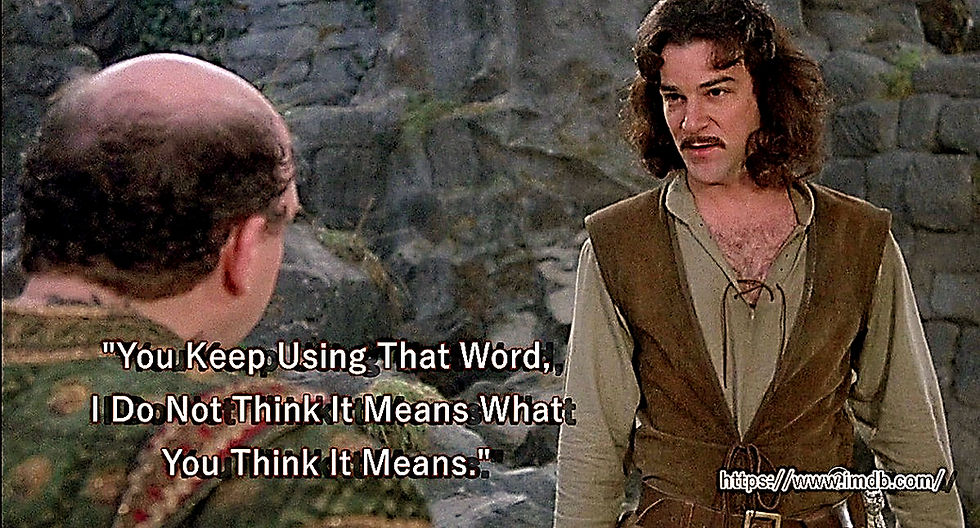
“You Keep Using that Word!”

Jul 22, 2025
6 min read
The Freedom of Getting Freedom Right!
What is freedom? I am not asking if you like freedom. Many readers live in countries that champion freedom and love it! I am asking if you have a biblical and spiritually empowering definition of freedom. Honestly, you may have only a fuzzy notion of what freedom is. You use the word, but like a character in the 1987 box-office hit, The Princess Bride, it does not “mean what you think it means!”
Your Definition Matters!
Many have a mistaken view of freedom, which hinders them from thinking clearly about their lives and the choices they make. So, let’s investigate. As a Ph.D. in Philosophy, I realize the notorious difficulty of establishing a technical definition of freedom, but we do not need to be technical. You can understand an easy explanation of biblical freedom. And gaining clarity will make your discipleship journey drastically easier. Just as your schoolteachers helped you clarify your initially blurry concepts, God’s process of intellectual/spiritual training in life involves moving from vague notions to specific and practical concepts. Let’s test your functioning definition of freedom (what you carry around in your head, even if you can’t define it).
True or False? Freedom is “the ability to choose to do something as well as not to do it."1
But Does God Have That Kind of Freedom?
That definition sounds accurate, and throughout history, many have attempted to define and defend it in those terms. The problem is that God Himself does not have that kind of freedom. He is holy and therefore cannot sin! So, he lacks “the ability to choose to” commit evil. By that flawed definition of freedom, he is not free! Furthermore, you lack that freedom now and will even more in the future. You will not commit murder today, because you do not want to!
So, you are not “free” to do anything or not do it! Furthermore, although we stumble and sin now, someday in heaven, in our most perfect and complete state, we will be like God, sinless and incapable of sin. Thank God for that! So, freedom must involve the ability to do what we want to do, not just the ability to do anything.
The Better Definition of Freedom
The Bible shows that we are free because “when we choose and act, we do so from prevailing desires which explain exactly why this choice and not another is made.”2 We may struggle with competing desires and conflicted emotions, but we base our decisions on reasons. That is precisely why we hold people morally accountable for their actions. Evil people choose to harm, to injure, to lie, etc., from premeditated thoughts.
Neither do people commit crimes randomly, nor do we sin randomly. We think, want, and we act. You are always free because, whether you admit it or not, you base every decision upon your highest values at the moment. This can be embarrassing, so we often say things that are not true, like, “I really wanted to…” or “I did not want to…” But that is not right! The harder, but honest truth is that we freely did or did not do things, even if they now embarrass us.
Two Reasons the Right Definition Matters for Christians!
1. The Power of Character Development!
First, the best way to make better moral decisions in the future is through character development. Instead of wondering why we failed, we can see that our mistakes flowed from our character: “I yelled at my children, because_________!” Not, “Why did I do that? I have no idea!” You were prioritizing something else above them in that moment: “Me-time,” embarrassment, unreasonable expectation, etc. If you had been a better person, you would not have done that. And in hindsight, it is hard to remember why you acted wrongly, but you were evil, so you did evil! If you had been and therefore felt more like Christ, you would not have done that.
That might be a depressing thought for an unbeliever, but for believers, we embrace grace and grow through such mistakes. There is the grace of forgiveness when we are honest about our sin. And God is growing our character. He predestined us to grow into the image of his Son (Romans 8:29). What great hope! Just as Jesus did not have to strain or fight to do good, but it was natural to him, so we, too, as we grow more like him, will find that the doing of the good gets easier.
That is also why character matters more for leadership roles than experience or skills. The qualifications for being a church elder/pastor or deacon emphasize the kind of person one is (1 Timothy 3:1-13; Titus 1:5-9), because they will tell you how someone will handle a new role. Jesus taught this: “A healthy tree cannot bear bad fruit, nor can a diseased tree bear good fruit” (Matthew 7:18).
2. The Power of Input!
We usually think about major decisions.
But what about the many minor decisions that

we make throughout the day? We do not have time to consider them for long, if at all. And although we should pray without ceasing, you probably cannot pray about every small decision. So, that leads to an interesting question. Since we have said that our “prevailing desires” make our decisions, where do these desires come from? They come from our values and preferences accumulated over a lifetime of observing and learning.
Hang around with moral people, and likely you will pick up better patterns of thought, speech, and behavior than being around evil people (Psalm 1:1). Proverbs 22:24 cautions: “Make no friendship with a man given to anger, nor go with a wrathful man.” Evil people always recruit more companions: “Come with us…” (Proverbs 1:11). In the same way, watching and reading immoral or even stupid, trivial stuff will taint your values and lead to bad decision-making. Our “tastes” that we develop determine our small choices, and the accumulation of small choices leads to larger ones.
John Piper is concerned that media consumption changes our values. But it is not the blatantly immoral that is most dangerous! Instead, it is the slow shifting of our values and gaze away from our great God and the good things he has made:
If all other variables are equal, your capacity to know God deeply will probably diminish in direct proportion to how much television you watch. There are several reasons for this. One is that television reflects American culture at its most trivial. And a steady diet of triviality shrinks the soul. You get used to it. It starts to seem normal. Silly becomes funny. And funny becomes pleasing. And pleasing becomes soul-satisfaction. And in the end the soul that is made for God has shrunk to fit snugly around triteness.3


du doan xsmb mình thấy dạo này hay xuất hiện nên tiện tay vào xem thử cho biết. Mình không phải kiểu ngồi soi kỹ từng cầu đâu, chủ yếu xem trang họ trình bày có dễ theo dõi không. Vào cái là thấy bài “Soi cầu MB ngày 3 9 2026” để tiêu đề rõ ràng, kéo xuống đọc lướt vẫn nắm được vì họ chia nội dung thành từng khối ngắn, không bị một cục chữ dài. Phần “Dự Đoán XSMB 3 9 2026” cũng được làm nổi bật ngay trong bài nên khỏi phải mò. Nói chung nhìn gọn, chuyển qua lại cũng nhanh, và cái heading “Dự Đoán XSMB 3 9 2026” nằm ngay trong khối…
I really like the phrase “Bible intake” rather than“Bible study.” It’s a little less intimidating. 😂 I definitely feel a difference in my day when I don’t begin it with some Bible “intake”!